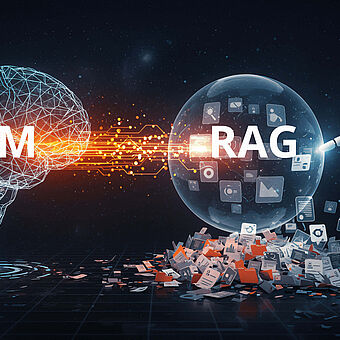
How generative AI makes decision optimization accessible to everyone
When algorithms learn to talk and chat
Adaptability is a core feature of modern AI-based decision-making and optimization algorithms, which can continuously adjust their behavior to new data situations and facts. A new development now promises to bring interaction with algorithms to a language-controlled level. This is made possible by combining AI decision-making and optimization algorithms with generative AI (Gen-AI) in retrieval-augmented generation (RAG) applications.
Bridge between AI optimization and human communication
This makes the fact-based, numerical part of the results easier to understand and fully explain in an intuitive way. It also allows process experts to comprehend and control the decision-making basis without needing to be data scientists themselves. In doing so, it bridges the gap between the highly specialized, data-science-oriented numerical processes of AI optimization and human communication in natural language.
What is the solution?
The latest generation of AI decision-making and optimization processes also integrates generative AI with RAG applications. In the future, generative AI - particularly in chat-oriented forms based on large language models (LLMs) such as Gemini - will be used to explain optimization results generated outside the LLM. This is achieved through the use of machine-learned decision patterns and by embedding subject- and process-specific documents from the relevant application area (RAG) into the AI context. The PSIqualicision AI Framework provides the PSIqualicision A2 (Ask and Answer) tool for this purpose, which combines LLMs with RAG components.

What are the benefits for the user?
The integration of Gen-AI-based RAG applications with AI decision-making and optimization software offers a wide range of advantages. First, it achieves a new level of language-oriented explainability, as the optimization results can be explained in an understandable way. These explanations can be based on results that have already been achieved or can be predictive of results that are yet to be achieved. The latter not only help to understand the decision-making situation but also provide guidance on how to control processes in a results-oriented manner. Second, this connection makes it possible to control the decision-making AI through verbally communicated preference settings. The system maps appropriately (also qualitatively) labeled output data and machine-learned consistent preferences via natural language input, thereby continuing to automatically control the AI optimization software. The configurability of the AI systems by the user tends to be linguistic, based on business process know-how.
What if algorithms learn to speak and chat?
The combination of adaptive AI decision-making and optimization software with Gen-AI-based RAG applications marks a significant step forward in development. It shifts interaction from a numerical to a linguistic level and significantly improves the explainability of results and the controllability of AI optimizations. By using LLMs and dedicated RAG-based document embeddings, the applications take on more of a chat-like character, although they can still optimize numerically with high efficiency. This allows adaptive AI algorithms to not only continuously calculate their results but also explain them in a way that is understandable to people with process expertise. Chatting at the business process level with AI decision-making and optimization algorithms is becoming a reality.