When facts learn to speak: PSI's Industrial AI framework
Facts and explainability for Industrial AI
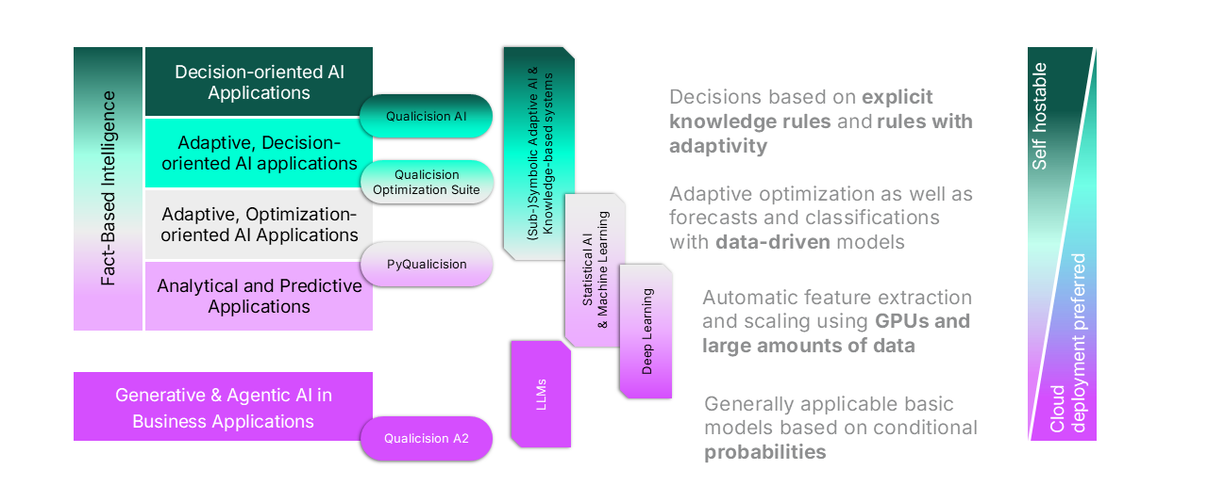
The PSI Industrial AI Framework provides a structured approach to integrating AI into PSI’s industrial applications. It combines fact-based AI algorithms with generative AI capabilities to deliver reliable results along with clear, natural-language explanations - essential in industrial environments. The framework is designed primarily to embed AI into existing and future PSI products, enhancing their functionalities rather than functioning as a stand-alone AI solution.
The PSI Industrial AI Framework consists of three interconnected layers: Adaptive Decisions & Optimization, Machine Learning-based Predictions, and Generative AI.
Fact-based intelligence: A foundation for industrial reliability
The framework's fact-based layers contribute to establishing determinism in industrial applications:
Adaptive decisions & optimization: This layer provides algorithms and components for decision-making, classification, sequencing and scheduling tasks. It utilizes techniques such as Qualicision, based on extended fuzzy sets, to detect and balance decision conflicts, enabling adaptive models and decision structures. Its capabilities include selecting and ranking of decision alternatives and adapting decisions to changing decision criteria.
AI-based predictions: This layer addresses prediction tasks using machine learning algorithms that operate on historicized data. It incorporates a full spectrum of techniques, including regression models, random forest methods and neural networks. The AI Predictions Layer offers a full-stack platform compatible with Google AI tools, including Vertex AI and others.
Generative AI: Facilitating understanding and efficiency
The Generative AI layer integrates capabilities that enhance PSI products by providing functionalities that resemble language-oriented content generation. This layer utilizes existing Large Language Models (LLMs), such as Google's Gemini, and combines them with information and knowledge fixed in manuals and process descriptions. In addition, it embeds Retrieval-Augmented Generation (RAG) into existing PSI tools and systems.
A key function of this layer is to support the Adaptive and Full AI Prediction layers by providing natural language explanations. For example, combining Generative AI with optimization capabilities provide for natural language-based explanations of numerical adaptive optimization algorithms - such as Qualicision-AI-based sequencing for optimization of production processes in discrete manufacturing.
The industrial approach: Integrating numerical reliability with explainability
The combination of numerical, fact-based AI algorithms - embedded in both the Adaptive Decisions & Optimization Layer and the Machine Learning-based Prediction Layer - with the natural-language explainability provided by RAG-based generative AI offers a range of advantages that are crucial in industrial environments:
- Enhanced reliability:
Fact-based AI algorithms are designed to manage complexity while adapting to continuously changing characteristics of industrial data. - Improved understandability:
RAG-based generative AI explains the results of AI algorithms in clear, accessible language aligned with the terminology used in specific business processes. - Domain-specific relevance:
By augmenting LLMs with proprietary and industry-specific process knowledge embedded in documents, domain-specific RAG/GenAI explanations are generated. This increases the reliability of explanations and minimizes the risk of hallucinations - moving closer to deterministic behavior. - Operational benefits:
Integration into PSI products supports tasks such as documentation and report generation while providing insights in an accessible format. This increases efficiency and operational performance across a wide range of use cases, including logistics, discrete manufacturing, process industries, metals, and energy management systems.
Outlook: Towards more active support with Agentic AI
Looking ahead, the future integration of an Agentic AI Framework into our PSI Industrial AI Framework will further enhance the synergy between fact-based intelligence and Generative AI. This development will lead to more active and proactive support within industrial applications, where AI systems will identify issues, suggest solutions and potentially initiate actions with reduced human intervention, contributing to increased operational efficiency and reliability.