How Würth Elektronik is harmonizing international logistics
One vision, many locations: balancing consistency and flexibility
International expansion creates a practical challenge for logistics organizations: how can warehouse processes be standardized across countries while still accommodating the operational requirements of individual sites?
For Würth Elektronik eiSos, this question has become increasingly relevant as its logistics network has expanded. The company uses PSIwms at its sites in Waldenburg, Germany, and Lyon, France, and is extending the system to its US location in Watertown. The aim is to establish an international warehouse management standard while taking the specific characteristics of each location into account.
The three locations represent different operational environments. Waldenburg operates a highly automated distribution center, while the warehouse in Lyon combines automated and manual processes. At the Watertown site, PSIwms is being introduced to replace processes that were previously dependent on workarounds and individual employee experience.
Different requirements, one system standard
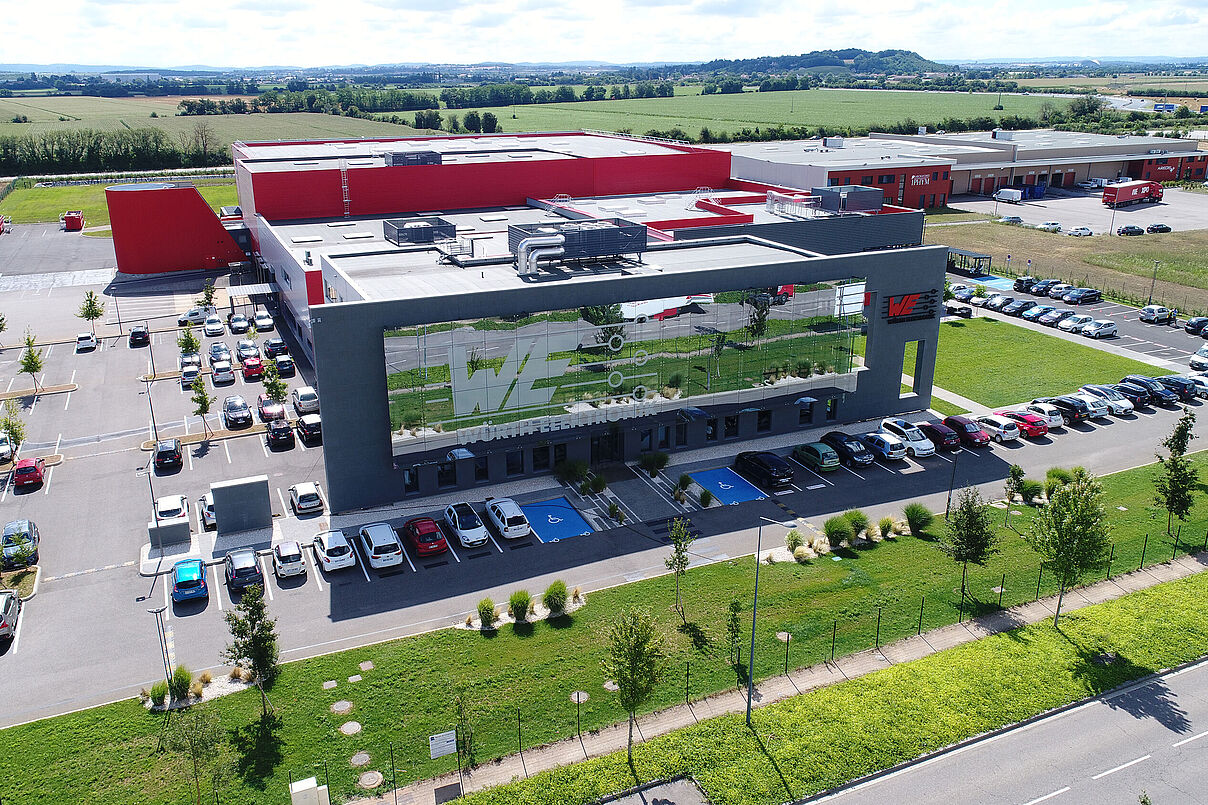
At Würth Elektronik's headquarters in Waldenburg, the warehouse stocks around 20,000 articles and handles approximately 2,000 delivery notes, 3,500 order lines and 8,000 bin accesses per day. The highly automated environment requires precise coordination between the warehouse management system and the site's material-flow technology. PSIwms supports this through system parameterization, including shipping carton and case calculation.
Waldenburg
In Lyon, around 4,500 articles are stored across approximately 35,000 storage locations. The site processes around 1,000 delivery notes and 2,500 order lines per day. Here, the challenge was to expand and partially automate previously manual processes while the warehouse remained operational. PSIwms coordinates logistics across different storage areas, from pallet and shelving racks to small-parts storage.
Lyon
Watertown presents another set of requirements. The site has around 7,000 active articles and approximately 20,000 storage locations. Previously, processes were heavily dependent on individual employee experience and manual workarounds. By applying the approach developed in Lyon, Würth Elektronik is introducing a system-guided warehouse strategy with defined roles, guided process steps and traceable bookings. The site now processes an average of more than 300 order lines per day, with peaks exceeding 1,300.
Watertown
A shared framework with local flexibility
The international standard is based on PSIwms Edition FLEX, implemented as an on-premise installation within Würth Elektronik's existing IT environment. Functions including 2D barcode handling, ESD processes, and re-reeling are used as standardized functional modules across the international implementations.
At the same time, PSIwms can accommodate site-specific requirements, including differences in label standards, barcodes and packaging processes, without requiring separate software solutions for each location. For Würth Elektronik, this creates a common framework within which local requirements can be addressed.
In our day-to-day operations, the advantage of a flexible, modular system is clear. We can make adjustments without leaving the overarching framework. This reduces friction, simplifies ongoing development, and ensures that improvements are not created as isolated, single-use solutions, but rather as reusable process building blocks.
The cooperation between Würth Elektronik and PSI has developed over approximately ten years. Over time, Würth Elektronik has also gained greater autonomy in managing smaller configurations, such as structuring warehouse zones. The company plans to further develop this self-sufficiency by building an internal international logistics team.
The partnership also extends beyond individual implementations. Würth Elektronik participates in the PSIwms Competence Group, a customer advisory group through which customers can contribute requirements and experience to the further development of PSIwms.
Building on experience across borders
The experience gained at one location can provide a starting point for the next. The approach developed in Lyon was used as a basis for the implementation in Watertown, while the different operational environments of the sites continue to be reflected within the shared framework.
The next step is the planned expansion of the international hub network into Asia. For Würth Elektronik, the existing standard provides a basis for further international implementations while allowing individual locations to take their own operational requirements into account.
As Marko Kübler puts it: “The roughly ten-year collaboration with PSI gives us the necessary continuity for an international standard.”
For PSI, the partnership illustrates how internationalization can work in practice. “Together with Würth Elektronik, we have created a framework that enables internationally unified processes while still taking the specific characteristics of individual locations into account,” says Julian Beike, Team Lead Project Management at PSI. “This is the ideal basis for continuing to expand the hub network and efficiently integrating additional locations into the standard.”
The case demonstrates that international standardization does not necessarily mean identical processes everywhere. A common technological framework can provide consistency while allowing individual sites to reflect their operational realities - creating a foundation for continued international growth.