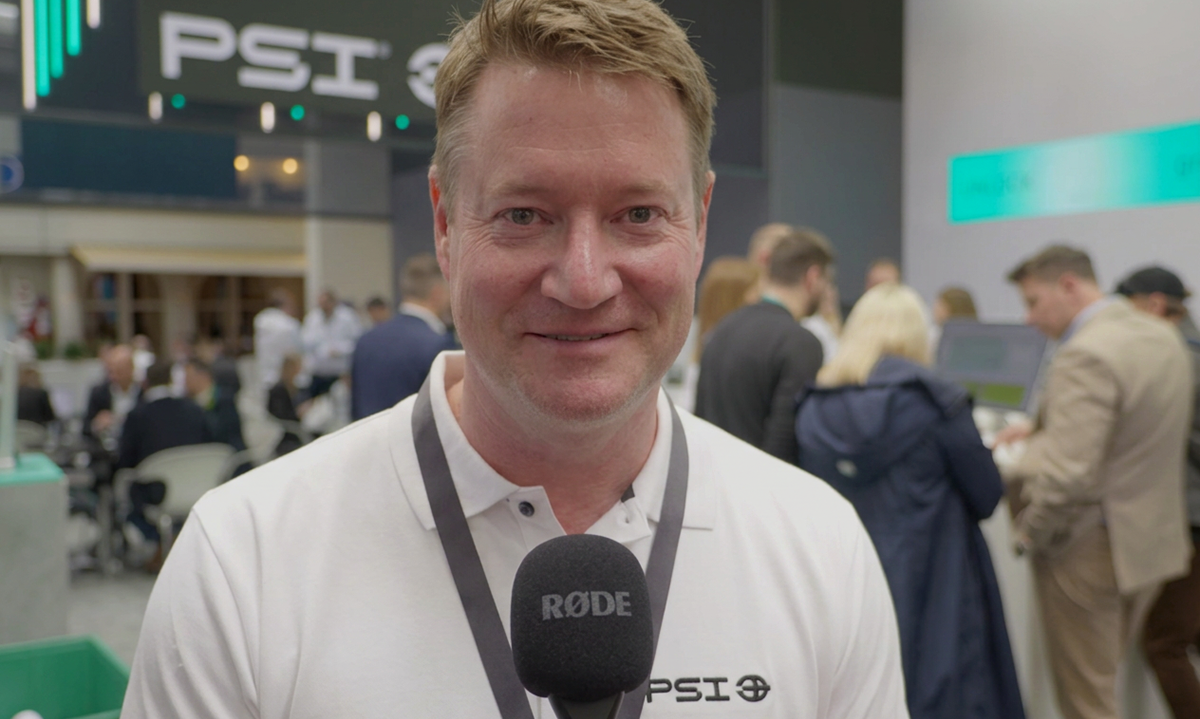
Timothy Kennedy on opportunities, challenges, and growth in the U.S.
Building a global presence: how PSI is bringing industrial intelligence to the US
The North American manufacturing market is undergoing significant change. Companies are investing in modern production capabilities, strengthening local supply chains, and looking for software solutions that can help them manage increasing complexity.
Timothy Kennedy, Head of Sales North America for PSI’s Discrete Manufacturing business unit, explains how PSI is building its presence in the region, why local market understanding matters, and how intelligent software solutions can help manufacturers become more flexible and competitive.
Tim has more than 20 years of experience helping organizations evaluate and implement complex software solutions. Throughout his career, he has worked with companies navigating major technology decisions and has developed extensive experience in aligning business requirements with practical solutions.
Q: You have described PSI's market entry in the U.S. as a "boots on the ground" strategy. What does that mean, and why is local presence so important?
A successful market presence starts with being close to customers. "Boots on the ground" means having local leadership and local expertise that can engage directly with companies, understand their challenges, and build long-term relationships.
PSI has built strong customer relationships in Europe over many years, and our colleagues in the DACH region have extensive experience supporting manufacturing companies. However, international expansion requires more than providing solutions remotely. Markets differ in their business cultures, operational approaches, and decision-making processes.
Being present locally allows us to better understand the specific needs of North American manufacturers and adapt our approach accordingly. But establishing a local presence is only the first step. Long-term success also requires building awareness and demonstrating that PSI provides proven solutions for modern discrete manufacturing environments.
Q: The U.S. market is highly competitive. How does PSI position itself for North American decision-makers?
North American manufacturers have access to many software solutions, but they are increasingly looking for systems that address the complexity of modern production environments. The key question is no longer simply how to manage transactions - it is how to make better operational decisions in real time.
PSI has decades of experience developing software specifically for industrial environments. Our ERP and MES solutions connect business processes with production operations, providing manufacturers with greater transparency and control on the shop floor.
Our Industrial AI capabilities, including intelligent sequencing and scheduling, address one of the most complex challenges manufacturers face: balancing multiple competing objectives such as delivery performance, resource utilization, and production efficiency.
A major part of our work in North America is communicating this value clearly and showing companies how PSI solutions can help them solve real operational challenges.
Q: What has been the most important factor in adapting PSI’s solutions, proven in the DACH region, to the North American market?
The technology foundation is highly transferable because many manufacturing challenges are global. Companies everywhere need reliable production processes, better transparency, and the ability to respond quickly to changing conditions.
However, the way we communicate value must reflect the market we are addressing. In the DACH region, customers often place strong emphasis on engineering depth, technical precision, and long-term reliability. North American decision-makers typically focus more strongly on measurable business outcomes, operational improvements, and return on investment.
Our approach is to combine both perspectives: maintaining the engineering strength and industrial expertise that define PSI while clearly demonstrating the business value our solutions deliver.
Q: How important are reference customers from the German-speaking region when approaching companies in North America?
Industry experience is one of PSI’s greatest strengths. Manufacturing challenges are often global, and our long history supporting demanding industries such as automotive and mechanical engineering demonstrates that our solutions are built for complex production environments.
German manufacturing is internationally recognized for engineering excellence, and our references from this region provide valuable evidence of our capabilities.
At the same time, North American companies naturally want to understand how solutions perform in their own environment. Local relevance matters. That is why customers with production facilities in North America are particularly important. They demonstrate that PSI technology is already supporting manufacturing operations under local conditions.
Building this growing base of regional references will be an important part of our continued expansion.
Q: What is the key advantage of PSI solutions compared with traditional manufacturing software approaches?
The key difference is that PSI solutions are designed around manufacturing processes themselves. Production environments are dynamic. Machine availability, material supply, priorities, and customer requirements can change constantly.
Manufacturers need systems that help them respond to these changes quickly and intelligently. PSI combines ERP, MES, and Industrial AI capabilities to connect planning decisions with real production conditions.
Our AI-based sequencing and scheduling solutions help companies manage complex planning scenarios by evaluating multiple objectives simultaneously. At the same time, explainable AI ensures that production teams understand why decisions are recommended - an important factor when introducing artificial intelligence into operational environments.
Q: Many manufacturers operate with fragmented IT environments. What challenges do you see in North America?
Many manufacturers have developed their IT landscapes over many years. As a result, they often operate with a combination of enterprise ERP systems, specialized applications, MES solutions, and manual tools such as spreadsheets.
The challenge is that these systems do not always communicate effectively. Important production decisions may be based on incomplete or outdated information, making it difficult to respond quickly to disruptions.
We see two common scenarios.
For mid-sized manufacturers, the challenge is often replacing fragmented legacy environments with a modern, integrated platform. PSI’s PSIpenta ERP and MES solutions provide a foundation designed specifically for discrete manufacturing.
For larger organizations, replacing an established enterprise system may not be realistic. In these cases, Qualicision AI can provide additional intelligence by working with existing applications and improving planning and optimization without requiring a complete system replacement.
Both approaches have the same objective: helping manufacturers improve decision-making while protecting ongoing production operations.
Q: How do PSI solutions help companies modernize without interrupting production?
Manufacturers are understandably cautious about technology changes because production continuity is critical.
Our approach focuses on structured implementation and minimizing operational risk. For companies introducing PSIpenta ERP and MES, this means a controlled transformation based on clearly defined processes and phased implementation.
For companies with existing enterprise systems, Qualicision AI provides another path by adding advanced optimization capabilities without requiring a complete replacement of existing investments.
The goal is always the same: helping manufacturers improve their operations while maintaining stability.
Q: Looking five years into the future, what role will PSI’s North American organization play?
Our goal is for North America to become an important part of PSI’s global innovation and customer strategy.
The manufacturing landscape in North America is changing rapidly. Companies are investing in new production capabilities, strengthening supply chains, and looking for ways to operate more efficiently. This creates significant opportunities for intelligent software solutions.
Our local organization will not only support customers in the region but also contribute insights that help shape future product development. The challenges faced by North American manufacturers will provide valuable input for PSI’s global innovation roadmap.
Ultimately, our ambition is to demonstrate that PSI’s solutions are not limited to one region. They are designed to support manufacturers worldwide in becoming more flexible, efficient, and intelligent.